Hair towels are everywhere. Women can choose from microfiber hair towel wraps, small towel turbans, oversized hair wraps, button-and-loop designs, strapped towels, pouch-style wraps and the traditional bath towel. Yet customer reviews across the hair-towel market repeatedly reveal many of the same frustrations.
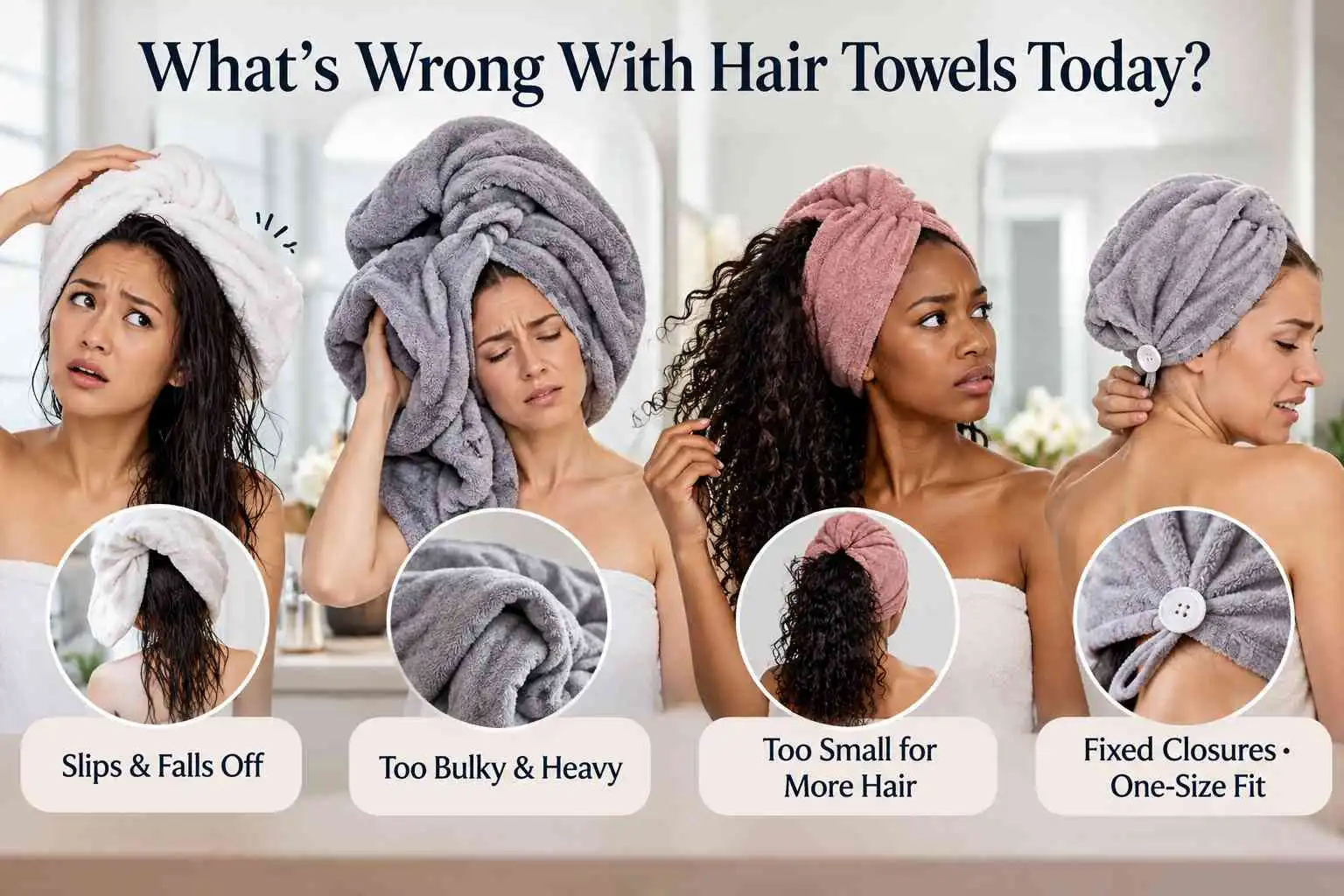
The towel slips. It falls off. It feels bulky. It is too small for long or thick hair. There is too much material for shorter or finer hair. A button or loop can be inconvenient. A fixed pouch may not accommodate the hair comfortably. Some microfiber feels soft and absorbent, while other microfiber can feel thin, rough or disappointing.
So what is actually wrong with today’s hair towel? Is it the design? Is it the size? Is it the microfiber? Is it the way the towel fits—or is it all of these things working together?
The answer is that there is no single hair-towel problem. A hair towel is a complete system. Material, absorbency, size, shape, weight, fastening method and fit all have to work together. When one part does not suit the wearer, even a towel with good microfiber can become frustrating.
Understanding those problems is important because the same words consumers use when searching for solutions—microfiber hair towel, hair towel wrap, lightweight hair towel, absorbent hair towel, secure hair towel, hair towel for long hair, hair towel for thick hair and curly hair towel—tell us what women are trying to improve.
Problem #1: Is the Hair Towel Design Outdated?
Many modern microfiber hair towels improved the fabric but kept a familiar turban-style construction. A typical design asks the wearer to place the towel over the hair, twist it, then pull the end toward a button, loop, strap or other fixed fastening point.
These systems can work well for some users, but every fixed closure creates a specific path the towel must follow. If a woman has more hair, less hair, a different head size or a different preferred wrapping tension, that fixed point may not land where she naturally needs it.
Built-in hair pouches create another fixed shape. They can simplify wrapping for some people, but long, dense or high-volume hair may not naturally fit into the same predetermined space.
The question is therefore not whether buttons, loops, straps or pouches are always bad. It is whether a modern hair towel should require every woman and every hair type to adapt to the same fastening system.
Problem #2: Is the Hair Towel Too Big—or Too Small?
The oversized bath towel
A bath towel was designed to dry the body. It needs enough fabric for the shoulders, arms, torso and legs. When wrapped around wet hair, much of that material can become unnecessary bulk. Once saturated, the towel may also become heavier.
This is one reason women search for a lightweight hair towel, microfiber hair towel or hair drying towel. They want enough absorbent material for their hair without carrying an entire bath towel on top of the head.
The tiny hair turban
At the opposite extreme is the small pre-shaped hair turban. Compact designs may work well for short or lower-volume hair, but long hair, thick hair, dense curls, coils, locks, extensions and weaves can require much more usable space.
If the towel is too short, hair ends may remain exposed. If the body of the towel is too small, the wearer may have to compress the hair, pull the towel tightly or struggle to reach the closure.
This explains the popularity of searches such as hair towel for long hair, hair towel for thick hair, large microfiber hair towel and extra-long hair towel. Consumers are looking for capacity—not simply a larger-looking product.
Problem #3: Why Does My Hair Towel Keep Slipping or Falling Off?
A super absorbent hair towel is not very useful if it will not stay on the head. Slipping can result from several factors: the towel may be too large, too small, poorly balanced, positioned incorrectly or dependent on a closure that does not match the wearer’s combination of hair volume and head size.
Hair itself also changes the balance. Long, wet hair creates weight along the towel. Thick or dense hair adds volume. Curly and coily hair may require more room. Fine or short hair may leave too much unused fabric inside a large turban.
A secure hair towel should remain comfortably positioned during ordinary movement without needing constant adjustment. Secure fit should not mean painfully tight fit.
That is why consumer phrases such as secure fit, stays in place, hair towel that stays on and comfortable hair towel wrap matter. Fit is not an extra feature. Fit is part of how the product performs.
Problem #4: Is All Microfiber the Same Quality?
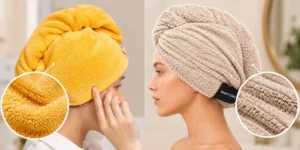
No. The word microfiber describes a category of very fine synthetic fibers, but microfiber hair towels can vary in fiber blend, fabric density, weave or knit, surface texture, softness, thickness and finishing.
One microfiber towel may feel plush, substantial and highly absorbent. Another may feel thin or rough. Two towels can both carry the words ‘microfiber hair towel’ while offering very different experiences.
For that reason, shoppers search for high quality microfiber hair towel, soft microfiber hair towel, absorbent hair towel, super absorbent hair towel and quick dry hair towel. They are not only looking for the material name—they are looking for performance.
Microfiber quality deserves its own discussion, which is why the next page in this Hair Towel Guide will examine GSM, softness, absorbency and fabric construction in more detail.
Problem #5: Why Is One Size Expected to Fit Everyone?
Women do not have one hair type, one hair length or one head size. Yet many hair towels are sold as though one fixed size should accommodate everyone.
A woman with short, fine hair does not need the same towel capacity as someone with waist-length, thick hair. Dense curly or coily hair may need additional room even when its visible length is shorter because of shrinkage. Locks, extensions and weaves can add both length and water weight.
Head circumference is another variable. Two people with the same hair length can experience the same towel differently because their head sizes and hair densities are different.
For that reason, hair towel for curly hair, hair towel for long hair, hair towel for thick hair, hair towel for coily hair and large hair towel wrap are meaningful searches. Consumers are describing their own fit problem directly to the search engine.
Problem #6: Does More Fabric Mean a Better Hair Towel?
It is tempting to solve a capacity problem simply by adding more fabric. But more fabric also means more material to wrap, more potential wet weight and potentially more bulk around the head.
A large towel may contain long hair but still feel cumbersome. A small towel may feel lightweight but fail to contain thick hair. Neither extreme automatically creates a better hair-drying experience.
The more useful design question is: where does the fabric actually need to be? A purpose-designed shape can provide usable length and capacity for the hair while reducing unnecessary material elsewhere.
That is the difference between simply making a towel bigger and designing the shape around how wet hair is actually wrapped.
What Should a Modern Hair Towel Do Better?
Once the recurring problems are separated, the requirements for a better hair towel become much clearer. Women are not searching for complicated technology. They are looking for a towel that works naturally with their hair and their routine.
Absorb excess moisture: A good absorbent microfiber hair towel should manage wet hair without aggressive rubbing.
Feel soft and gentle: The material should be comfortable against wet hair and skin.
Stay lightweight: The towel should avoid unnecessary wet weight and bulk.
Provide enough capacity: Long, thick, curly, coily or added hair needs sufficient usable room.
Offer appropriate sizing: Hair length, density and head size should influence fit.
Stay securely in place: The towel should remain comfortably positioned during normal movement.
Use a purposeful shape: Fabric should be placed where the hair needs it rather than added everywhere.
Keep the routine simple: A hair towel should simplify wrapping wet hair rather than create another complicated fastening process.
These Problems Inspired a Different Hair Towel Design
Smart Hair Towel™ began with these same questions. What if the hair towel problem was not only the microfiber? What if the shape, size, bulk and fastening method needed to be reconsidered too?
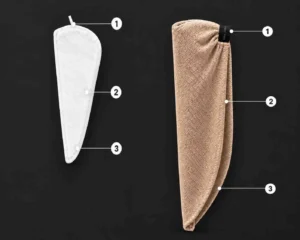
Instead of starting with a large bath towel and making it smaller—or starting with a tiny turban and asking every head of hair to fit inside it—the Smart Hair Towel design uses a slim, tapered profile intended to follow the direction in which the hair is wrapped.
Elastic is positioned at the back of the neck to help establish the fit. The towel is then wrapped, twisted and tucked. The design does not rely on a traditional button-and-loop closure, separate strap or built-in hair pouch.
Medium and Large options recognize another basic reality: different hair lengths, volumes and head sizes need different amounts of room.
SMART HAIR TOWEL™
Slim Shape. Firm Fit.
No loops. No hoops. No buttons. No straps. No hair pouch.
Wrap. Twist. Tuck & Go™.
This page does not suggest that every traditional hair towel is wrong for every woman. It is to show why the category still leaves room for a different approach—and why Smart Hair Towel was designed around the problems women continue to experience with fit, bulk, size and fastening.
The Next Question: What About the Microfiber Itself?
Design is only one part of the story. Once a hair towel has the right shape and fit, the fabric still matters. Not all microfiber is equal, and words such as soft, plush, high quality, absorbent and quick dry can describe very different materials.
The next page explores what GSM means, why higher GSM is not automatically better, how microfiber quality affects softness and absorbency, and what consumers should look for when comparing microfiber hair towels.