The Familiar Bath-Towel Habit
For generations, the standard cotton bath towel has done double duty: dry the body, then wrap the hair. It is familiar, convenient and already hanging in the bathroom. But a towel designed to cover the body is not necessarily the ideal shape, size or weight for wet hair.
That is one reason searches for microfiber hair towel, cotton hair towel, hair drying towel, wet hair towel and quick dry hair towel have become part of the modern hair-care conversation. Women are not only asking what absorbs water; they are also asking what feels comfortable, stays in place and treats wet hair gently.
Microfiber vs. Cotton: What Is the Difference?
Cotton towels
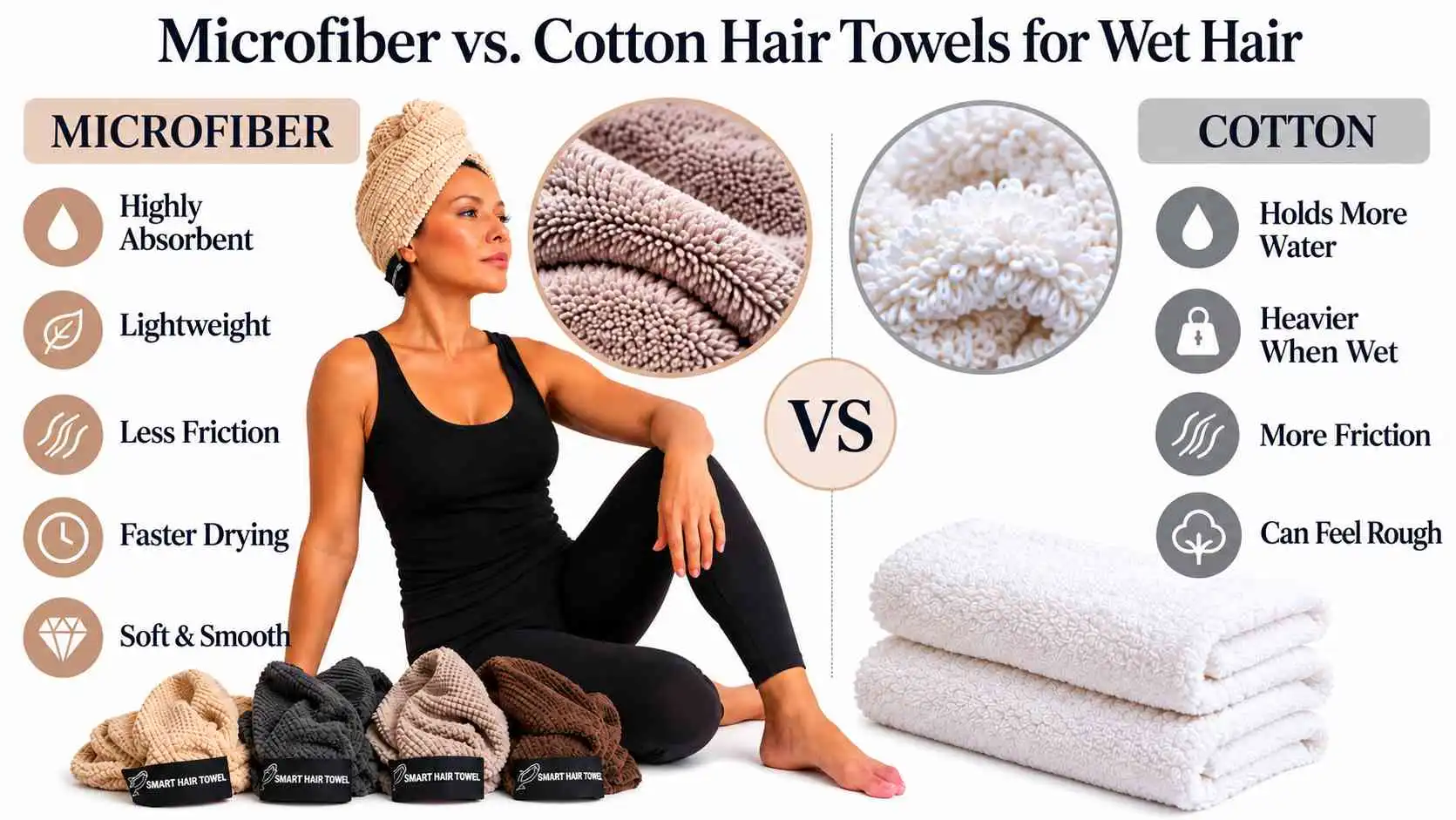
Cotton is a natural fiber widely used for bath towels because it is soft, familiar and absorbent. Terry cotton towels use loops of yarn to increase surface area and help collect water from the skin and hair.
Microfiber towels
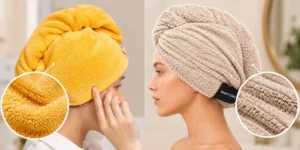
Microfiber is made from very fine synthetic fibers, commonly polyester and polyamide. The fine fiber structure creates substantial surface area in a relatively lightweight fabric. For hair towels, microfiber can be woven or knitted in different ways, so quality, thickness, softness and absorbency can vary considerably from one product to another.
The important point is that ‘microfiber’ is a material category, not a guarantee that every microfiber hair towel performs the same way.
Water Absorption and Drying
Both cotton and microfiber can absorb water. The experience differs because fiber structure, fabric density, towel dimensions and construction all influence how quickly a towel takes up moisture and how heavy it becomes.
A specialized absorbent hair towel is designed to manage excess water from the hair without requiring the amount of fabric used in a full-size bath towel. Removing excess moisture can make the next stage of the routine—air drying, styling or blow drying—more manageable.
A quick dry hair towel should therefore be understood as a tool for efficiently removing excess moisture, not as a promise that every hair type will become completely dry in a fixed number of minutes.
Weight, Bulk and Comfort
A large cotton bath towel can hold substantial water, but once wrapped around the head it may also feel bulky and heavy. The extra fabric needed to dry the body is unnecessary when the towel is being used only for hair.
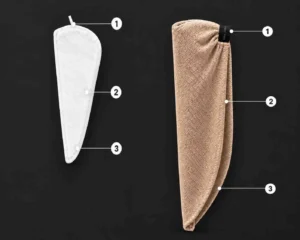
A lightweight microfiber hair towel can use less overall material while still providing enough surface area to manage wet hair. Shape matters too: a towel designed specifically for hair can distribute fabric more intentionally instead of stacking a large bath towel high on the head.
For people who move around while getting dressed, applying skincare or doing makeup, comfort and a secure fit can matter just as much as absorbency.
Friction, Frizz and Breakage-Conscious Hair Care
The way a towel is used matters as much as the towel itself. Vigorous rubbing can create friction, tangling and a rougher hair surface. Wet hair can also stretch more readily than dry hair, so gentle handling is especially important.
Instead of scrubbing wet hair, a gentler routine uses the towel to blot, wrap and absorb excess moisture. For that reason, terms such as anti-frizz hair towel, gentle hair drying towel, reduce friction and breakage-conscious hair care appear frequently throughout the microfiber hair towel market.
No towel can guarantee the elimination of frizz or breakage, because hair condition, texture, products, styling and technique all matter. But reducing unnecessary rubbing and pulling is a sensible part of a gentler wet-hair routine.
Which Is Better for Different Hair Types?
Curly, wavy and coily hair
Curly, wavy and coily textures often benefit from drying methods that avoid aggressive rubbing and help preserve the natural curl or wave pattern. A microfiber hair towel for curly hair can be used to blot, wrap or support techniques such as hair plopping.
Long and thick hair
Long hair and thick hair introduce another issue: capacity. A towel may be soft and absorbent but still fail if it is too short or too small to contain the hair comfortably. For these customers, towel length, width, shape and size options matter.
Fine and straight hair
Fine or straight hair may not require as much towel volume, but gentle handling and lightweight comfort remain valuable. A smaller or slimmer towel can avoid unnecessary bulk.
Does That Mean Cotton Is Bad for Hair?
No. Cotton is an excellent textile and remains a practical choice for many uses. A soft cotton towel can certainly remove water from hair, especially when used gently.
The comparison is really about purpose. A large cotton bath towel is designed primarily for drying the body. A specialized microfiber hair towel is designed around wet hair—its moisture, length, volume, weight and the need to keep the towel comfortably positioned on the head.
For many consumers, the advantage is therefore not simply ‘microfiber versus cotton.’ It is a purpose-designed hair towel versus using a general-purpose bath towel.
What Should You Look for in a Microfiber Hair Towel?
Microfiber quality: Look for a soft material that feels gentle rather than thin, rough or scratchy.
Absorbency: The towel should efficiently remove excess moisture.
Weight: A hair towel should be comfortable even after absorbing water.
Size: Choose a size that accommodates hair length, thickness and head size.
Shape: A purpose-designed shape can reduce unnecessary bulk.
Fit: The towel should remain comfortably in place during a post-shower routine.
Fastening method: Consider whether you want buttons, loops, straps, pouches or a simpler wrap-and-tuck system.
Washability: Follow care instructions so microfiber performance and construction hold up over repeated use.
Where Smart Hair Towel™ Fits
Smart Hair Towel™ approaches the problem from both material and design. It uses soft, absorbent microfiber, but the concept does not stop at fabric. The towel was designed with a slim, tapered shape intended to reduce the bulk associated with traditional bath towels and many conventional hair turbans.
Instead of a traditional button-and-loop closure or a hair pouch, Smart Hair Towel™ is designed around a simple wrap, twist and tuck method, with elastic positioned at the back of the neck to help create its firm fit.
SMART HAIR TOWEL™ — Slim Shape. Firm Fit.
No loops. No hoops. No buttons. No straps. No hair pouch.
Wrap. Twist. Tuck & Go™.
Medium and Large size options allow customers to consider their hair length, thickness and head size rather than relying entirely on a one-size approach.
The Takeaway
Microfiber and cotton can both absorb water, but a purpose-designed microfiber hair towel offers a different combination of weight, shape, fit and moisture management than a standard cotton bath towel.
The best option depends on hair type, length, thickness, comfort preferences and drying routine. Whatever the material, gentle handling is more important than aggressive rubbing.
There is also another important question: are all microfiber hair towels equal? The answer is no. Microfiber quality, fabric density, softness, weave and absorbency can differ significantly. That is the story we explore next in Page 3: Not All Microfiber Hair Towels Are the Same—GSM, Quality & Absorbency.