Quality • GSM • Texture • Absorbency • Quick Drying • Hair Wraps • Hair Care
The Story Behind the Microfiber Selection
The material choice for Smart Hair Towel™ began with a practical problem: the word “microfiber” appeared on many hair towels, but the products did not all feel or perform alike. During product development, competing hair towels were purchased and examined firsthand. Consumer feedback and complaints were studied, especially comments about absorbency, thin material, bulky wet towels, fit and the overall hair-drying experience.
Those comparisons made one point clear: choosing a hair towel cannot be reduced to a single fabric label or a single GSM number. Some microfiber felt thin or flat. Some felt soft but did not provide the substantial texture expected from a hair-drying towel. At the opposite extreme, adding more fabric could create unnecessary bulk and wet weight.
The design goal became a balance of softness, plush texture, density, absorbency, thickness, weight, comfort and durability. That material also had to work with a slim-shaped towel rather than simply recreating a smaller bath towel.
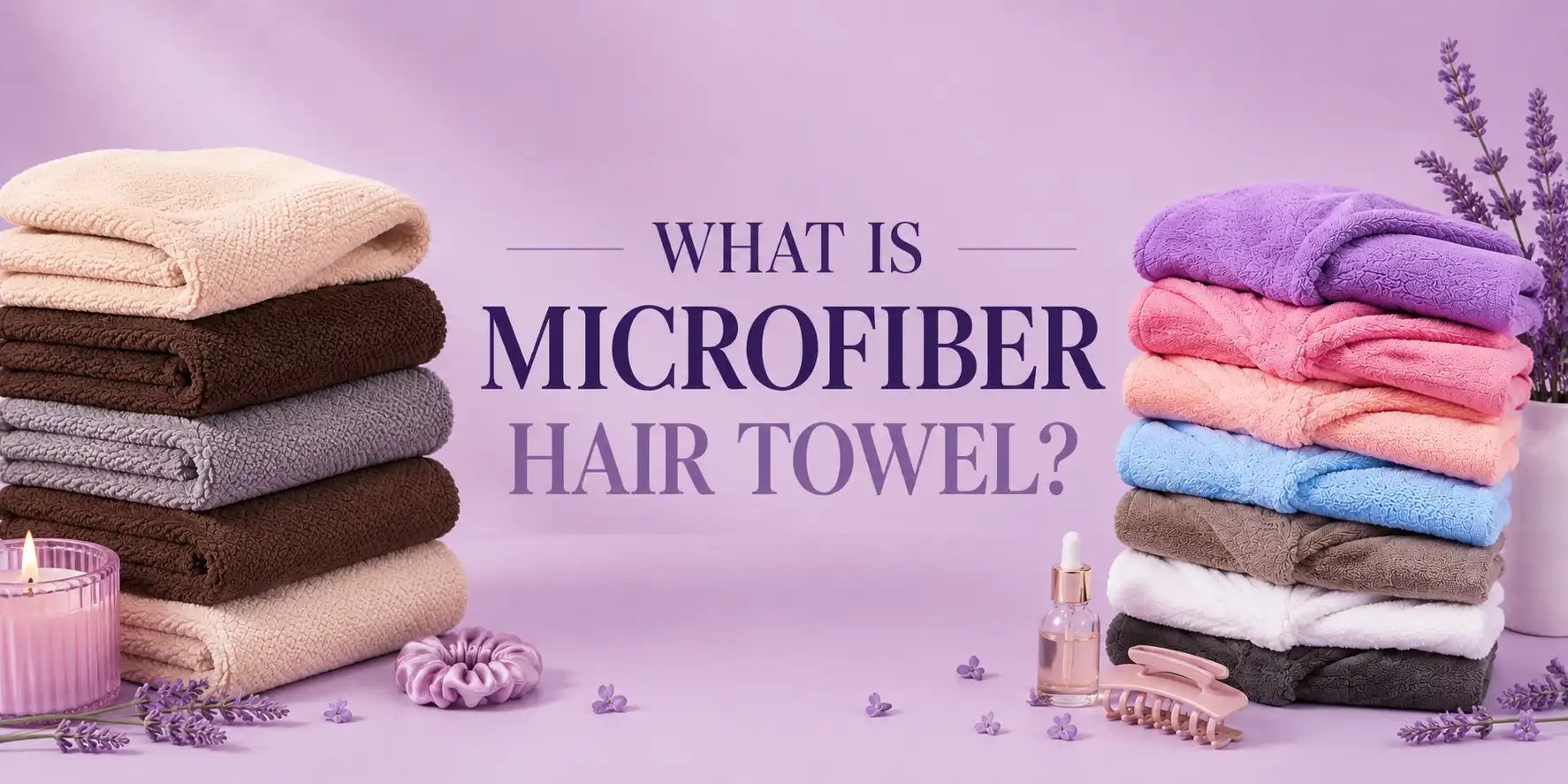
What Is a Microfiber Hair Towel?
A microfiber hair towel is made from extremely fine synthetic fibers and is designed to manage moisture after washing the hair. Microfiber fabrics commonly use polyester and polyamide in varying proportions. Their fine-fiber structure and construction can create a large surface area for interacting with moisture.
For hair drying, the material is only part of the experience. A useful microfiber towel for hair brings together absorbency, softness, size, shape, finished weight and fit. For that reason, consumers may encounter several names for the same general category, including microfiber hair towel wrap, microfiber hair wrap, hair drying wrap, wet hair wrap, microfiber hair turban and hair towel turban.
Hair Towel Wrap, Hair Turban or Microfiber Hair Wrap: What Is the Difference?
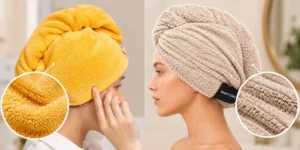
Shoppers often use “hair towel wrap,” “hair turban,” “microfiber hair wrap” and “hair drying towel” interchangeably. Many traditional hair turbans use a tapered pouch-like form with a button-and-loop closure. Other hair towel wraps use straps, loops or additional fastening pieces. These terms describe a category, but they do not mean every product uses the same construction.
Smart Hair Towel™ uses a different approach. It is a patented slim-shaped microfiber hair towel wrap designed without conventional loops, hoops, buttons, straps or a predefined hair pouch. The towel is wrapped around the hair, twisted and tucked, with an elastic component positioned at the back of the neck as part of the design. For shoppers searching for an alternative to a traditional microfiber hair turban or bulky bath towel, the difference is in the shape and securing method.
What Does GSM Mean in a Microfiber Hair Towel?
GSM stands for grams per square meter. It describes the weight of fabric over a standard area and can help indicate how much material is present. GSM is often associated with density, thickness and plushness, but a higher number does not automatically mean a better towel.
Smart Hair Towel™ uses approximately 400 GSM plush microfiber. The specification was selected as part of the complete material and product design. One practical way to evaluate microfiber quality is: fiber composition + construction + density + GSM + texture + finishing + product design.
Cheap Microfiber vs. High-Quality Microfiber
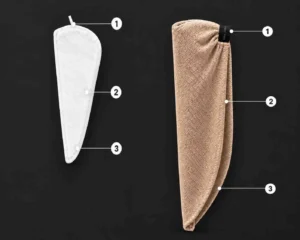
VISUAL COMPARISON: Thin, low-quality microfiber versus a substantial hair-towel material.
Texture and softness: A hair towel sits directly against wet hair and the scalp, so the surface should feel comfortable rather than harsh.
Density and thickness: A useful towel needs enough material to manage moisture, while unnecessary thickness can add bulk and wet weight.
Absorbency: The fabric should help move moisture away from wet hair without requiring aggressive rubbing. Construction and fiber composition matter along with GSM.
Weight: A towel can feel substantial while still being designed to avoid the size and bulk of a full bath towel.
Durability: Quality also includes how well the material, seams, elastic and overall construction hold up through proper repeated laundering.
Quick-Dry and Fast-Drying Hair Towels: What Those Searches Really Mean
“Quick dry hair towel,” “quick drying hair towel” and “fast drying hair towel” are common ways shoppers describe what they want: a towel that efficiently manages excess water after a shower without the size and wet weight of a full bath towel. These phrases are widely used in the hair-towel market, but drying performance depends on more than a marketing label.
Fiber composition, microfiber structure, density, surface construction, GSM, usable fabric area, hair length, hair density and how wet the hair is all influence the experience. Smart Hair Towel™ therefore focuses on material quality and efficient shape rather than making an unsupported promise that every person’s hair will dry by a fixed percentage or within a fixed time.
Absorbency is not determined by one marketing word. Fiber composition, microfiber structure, density, surface construction, GSM and the amount of usable fabric all contribute. Evaluating the actual towel can reveal more than simply reading “microfiber” or “super absorbent” on a label.
Microfiber Hair Towel vs. Cotton Bath Towel
Cotton bath towels are useful for drying the body, but a full-size bath towel was not necessarily designed around the size, weight and fit needed for wet hair. Once a large cotton towel absorbs water, the combination of fabric and retained moisture can create considerable bulk on the head.
A purpose-designed microfiber hair towel can use less overall material while still providing an absorbent surface for the hair. That can make the finished wrap lighter and less bulky. For someone searching for a hair towel alternative to a bath towel, the meaningful comparison is not simply microfiber versus cotton; it is also whether the material and shape were designed specifically for hair.
Why Hair-Towel Weight and Secure Fit Matter
A large towel becomes heavier as it takes on water, and that weight is carried on the head and around the neck. A lightweight hair towel or secure hair towel wrap can reduce unnecessary bulk compared with balancing a large wet bath towel on the head.
Fit matters too. A hair towel that continually loosens or slides may require repeated adjustment. Smart Hair Towel™ was developed around the idea that the towel’s shape and wrapping method should help create a close, firm fit without relying on a conventional button-and-loop closure.
Gentle Hair Drying and Frizz-Prone Hair
Consumers frequently search for an “anti-frizz hair towel” or “frizz reducing hair towel.” A towel should not promise to eliminate frizz for every person, because hair behavior depends on texture, condition, products, weather and styling. What a soft microfiber surface can support is a gentler drying routine that avoids unnecessary vigorous rubbing of wet hair.
This makes a soft microfiber hair towel relevant for straight, wavy, curly, coily, textured, natural, fine, thick, coarse and frizz-prone hair. The next guide explores those differences in greater detail.
Does Microfiber Shrink?
Quality synthetic microfiber generally has good dimensional stability when washed and dried according to the care instructions. This matters for a shaped hair towel because maintaining its intended dimensions helps preserve the way it wraps and fits. Excessive heat or improper laundering can still affect synthetic fibers, elastic and other components.
Microfiber Hair Towels for Every Hair Type
A quality microfiber hair towel can be considered for straight, wavy, curly, coily, textured and natural hair, as well as fine, medium, thick and coarse hair. Hair length and density also matter, including short, medium, long and extra-long hair, along with locs, dreadlocks, braids, extensions and weaves.
Choosing well depends on more than hair type alone. Length, thickness, density, texture, head size, towel dimensions and preferred fit all matter. Continue to Blog Page 2, “The Complete Guide to Hair Types & Textures,” for detailed guidance.
How to Care for a Microfiber Hair Towel
Proper laundering helps protect microfiber performance. Follow the product care label, avoid excessive heat, and avoid products that leave coatings on the fibers when the care instructions advise against them. Proper care helps preserve softness, texture, absorbency, shape and useful life.
What Should You Look for in a High-Quality Microfiber Hair Towel?
Microfiber quality — How does the material actually look and feel?
GSM — Is the fabric substantial enough for its intended use without creating unnecessary weight?
Texture — Is the surface soft and comfortable against wet hair?
Absorbency — Does the construction manage moisture effectively?
Weight — Will the towel remain comfortable once wet?
Size — Does it suit your hair length, density and volume?
Shape — Was the product designed specifically to wrap hair?
Fit — Does it stay comfortably and securely in place?
Construction — How are the fabric, seams, elastic or other components assembled?
A Different Approach to the Microfiber Hair Towel Wrap
Smart Hair Towel™ combines approximately 400 GSM plush microfiber with a patented slim-shaped design created specifically for wrapping wet or dry hair. The design considers what the towel is made from, how much material is needed, where it sits on the head, how it wraps and how it stays secure.
Smart Hair Towel™ — Slim Shape. Firm Fit.
No loops. No hoops. No buttons. No straps. No hair pouch.
Just Wrap, Twist, Tuck & Go™.
Frequently Asked Questions About Microfiber Hair Towels
What is a microfiber hair towel wrap?
It is a purpose-designed towel made with microfiber and shaped or used to wrap wet hair after washing. Designs vary widely, including turbans, pouches, rectangular wraps and slim-shaped wraps.
Is a hair towel wrap the same as a hair turban?
The terms often overlap in shopping searches, but construction differs. Many hair turbans use a pouch-like shape and button-and-loop closure, while other wraps use different shapes and securing methods.
What does GSM mean in a microfiber hair towel?
GSM means grams per square meter and describes fabric weight over a standard area. It can help indicate density and plushness but should be evaluated with fiber composition, construction and intended use.
Is 400 GSM good for a microfiber hair towel?
A 400 GSM microfiber can provide a plush, substantial feel when paired with an appropriate fiber construction and product design. GSM alone does not determine quality.
What makes a quick-dry hair towel effective?
The experience depends on fiber composition, microfiber structure, density, surface construction, GSM, usable fabric area and the amount and type of hair being wrapped.
Is microfiber better than a cotton bath towel for drying hair?
They serve different purposes. A purpose-designed microfiber hair towel can provide an absorbent surface with less overall fabric and bulk than a full-size cotton bath towel.
Can a microfiber towel help with a gentler anti-frizz routine?
A soft microfiber surface can support gentle drying by reducing the need for vigorous towel rubbing. It should not be presented as a guarantee that frizz will be eliminated.
Are microfiber hair towels only for curly hair?
No. They can be used across straight, wavy, curly, coily and textured hair. Size and design should also reflect hair length, thickness, density and volume.
How can I tell if a microfiber hair towel is high quality?
Look beyond the word microfiber. Consider softness, texture, density, GSM, absorbency, finished weight, durability, size, shape, fit and construction.
Author & Firsthand Experience
Written from the product-development experience behind Smart Hair Towel™. The microfiber selection was informed by consumer feedback, firsthand purchase and evaluation of competing hair towels, material comparison, product testing and the inventor’s own experience using microfiber hair towels.