Microfiber Is on the Label — But What Does That Really Tell You?
Search for a microfiber hair towel online and you will find hundreds of choices. Many use the same familiar descriptions: soft, lightweight, super absorbent, quick dry, gentle and anti-frizz. From a product photo, one microfiber hair towel can look very similar to another.
But once the towel is in your hands, the experience can be completely different. One may feel soft and substantial. Another may feel thin, slick or noticeably synthetic. One may absorb excess water efficiently, while another may leave the customer wondering why a product advertised as an absorbent hair towel does not perform the way she expected.
Why? Because microfiber is a material category — not a single standard of quality.
To understand what makes a high quality microfiber hair towel, we have to look beyond the word on the label and examine the fiber, fabric density, weave or knit, softness, absorbency, thickness, finishing and overall product construction.
1. What Does “Microfiber” Actually Mean?
Microfiber generally refers to very fine synthetic fibers, commonly made from polyester and polyamide. These fine fibers can create a large amount of surface area relative to the fabric’s weight, which is one reason microfiber is widely used in absorbent products.
However, saying a towel is microfiber does not tell you how dense the fabric is, how it was constructed, how soft it feels, how much water it can manage or how durable it will be. That is why two products can both be sold as a microfiber hair towel or microfiber hair towel wrap while delivering very different experiences.
2. Why Do Some Microfiber Hair Towels Feel Thin or Cheap?
Manufacturers make products for different price points. Lower-cost microfiber products may use less material, different fiber blends, lower fabric density, simpler finishing or economical construction. Those choices can reduce manufacturing cost, but they can also influence the hand feel, thickness, softness and perceived quality of the finished towel.
A consumer may describe such a towel as thin, slick, plasticky or overly synthetic. That does not mean every lightweight microfiber towel is low quality. It means lightweight and low-substance are not the same thing.
A well-designed lightweight hair towel can reduce overall bulk through its shape while still using a soft, substantial and absorbent microfiber fabric.
3. Why Doesn’t Every Microfiber Towel Absorb Water the Same Way?
Absorbency is more complicated than simply choosing a fabric called microfiber. Fiber fineness, blend, surface structure, weave or knit, fabric density and finishing can all influence how the material interacts with water.
The amount of hair also matters. Long, thick, curly or coily hair can carry considerably more water than short or fine hair. Even a good absorbent hair towel needs enough usable capacity for the hair it is expected to manage.
This is why terms such as super absorbent hair towel and quick dry hair towel should be considered together with towel size, fabric quality and construction rather than treated as stand-alone promises.
4. What Does GSM Tell You?
GSM means grams per square meter. It measures the weight of a fabric over a standard area. In general, a higher GSM means more material is present within that area.
GSM is useful, but it is not a universal quality score. A higher GSM does not automatically create the best microfiber hair towel, just as a lower GSM does not automatically make a towel poor quality.
For hair use, the better goal is balance: enough fabric density for softness and moisture management without creating unnecessary wet weight and bulk on the head.
5. Thin and Lightweight Are Not the Same Thing
Consumers often want a lightweight hair towel because a large wet bath towel can feel heavy. But reducing weight can be accomplished in more than one way.
One approach is simply to use less or thinner material. Another is to redesign the towel so that unnecessary fabric is removed from areas where it is not needed while maintaining quality microfiber where the hair needs coverage.
This distinction is central to modern hair-towel design: lightweight should describe the wearing experience, not necessarily a sacrifice in fabric quality.
6. What Do “Premium,” “Soft,” “Quick Dry” and “Super Absorbent” Really Mean?
These phrases are common throughout the hair-towel market because they describe qualities consumers want. But they can be difficult to judge from a product title or photograph alone.
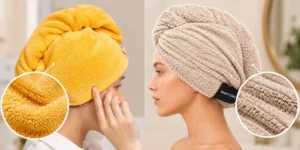
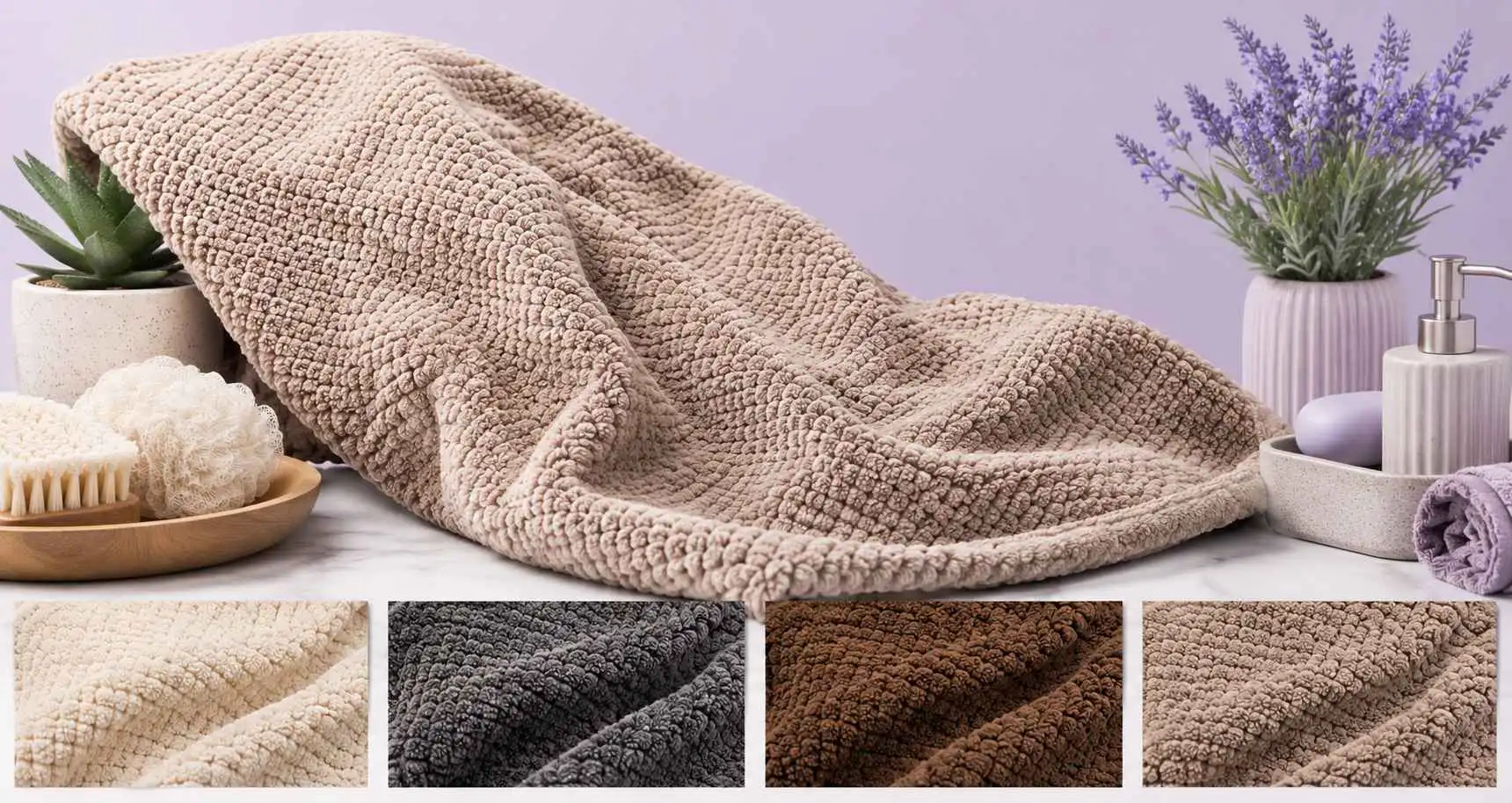
A shopper should look for supporting information: fabric specifications when available, close-up images of texture, customer feedback about softness and absorbency, appropriate sizing, construction details and clear care instructions.
No single marketing phrase can replace the complete product experience. A soft microfiber hair towel also needs the right size and shape. A super absorbent hair towel still needs to fit. A quick dry hair towel should still be comfortable and easy to wear.
7. Why Microfiber Quality Matters for Different Hair Types
Hair type changes what a towel has to manage. Curly and coily hair may benefit from gentle blotting, scrunching or plopping techniques that avoid rough rubbing. Long and thick hair can require more absorbent capacity. Fine hair may need less overall towel volume.
That means a microfiber hair towel for curly hair, a hair towel for thick hair and a hair towel for long hair may share the same basic material but require different amounts of usable fabric and different fit considerations.
Quality microfiber is therefore only one piece of the solution. The material must work together with towel dimensions, shape and fit.
8. How Can You Recognize a Quality Microfiber Hair Towel?
- Feel the fabric: Look for a soft, comfortable hand feel rather than relying only on the word microfiber.
- Consider absorbency: The towel should remove excess moisture without requiring aggressive rubbing.
- Look beyond GSM: Use GSM as one specification, not the entire definition of quality.
- Check the size: Make sure there is enough capacity for your hair length and density.
- Consider the shape: A purposeful shape can reduce bulk without simply making the fabric thinner.
- Evaluate the fit: A quality towel should remain comfortably positioned during normal movement.
- Inspect construction: Seams, elastic and finishing matter for repeated use.
- Read care instructions: Proper laundering can help preserve microfiber performance.
9. Why Microfiber Quality Matters to Smart Hair Towel™
Smart Hair Towel™ was designed around the idea that material quality and product design have to work together. The goal is not simply to put the word microfiber on a label.
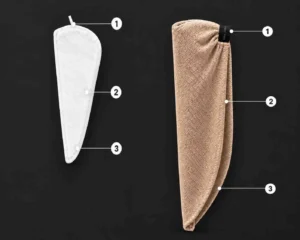
The microfiber needs to feel soft and substantial, manage excess moisture and remain comfortable when wrapped around wet hair. At the same time, the towel’s slim, tapered shape is intended to reduce unnecessary overall bulk rather than relying on extremely thin fabric to make the product feel lightweight.
Medium and Large options provide different amounts of room for different hair lengths, densities and head sizes. Elastic positioned at the back of the neck helps establish the fit, followed by the Smart Hair Towel wrap, twist and tuck method.
SMART HAIR TOWEL™ — Slim Shape. Firm Fit.
Quality microfiber + purposeful design + the right fit.
10. The Takeaway
Not all microfiber hair towels are the same. The word microfiber tells you what family of material you are considering, but it does not by itself tell you the towel’s softness, density, absorbency, thickness, construction, size or fit.
The best microfiber hair towel should be evaluated as a complete product. Material quality matters, but so do shape, capacity, weight and the way the towel works with real hair.
That is the larger lesson behind the Hair Towel Guide: understand the material, understand the design, understand your hair — and then choose the towel that brings those pieces together.